By the late 19th century, the Reform Movement in America had organized into a distinct denomination of Judaism, stressing rationalism, ethics, and universalism. As part of this project, the reformers had diminished and discouraged traditional expressions of piety as not in accordance with the “spirit of the age.” In addition to this, many of the people attracted to Reform were primarily interested in assimilating to the broader culture while maintaining a Jewish identity without the inconvenience of traditional halakha. The combination of rationalistic universalism, diminished ceremony, and widespread apathy among the laity created a deadening effect on Reform Jewish religious feeling.
Around the same time, Mary Baker Eddy claimed to have “discovered” the principles of Christian Science. Christian Science was a theological system and new religious movement which stressed spiritual healing and closeness with God, which Eddy described as Mind, Spirit, Soul, Principle, Life, Love, and Truth. Eddy’s understanding of God rejected the Trinity and anthropomorphism, all the while retaining the understanding of God as loving and all-knowing. The movement gained widespread popularity, in large part due to the abysmal state of medical science and the promise of miraculous healing. This popularity also affected the assimilated, mostly Reform-affiliated, Jewish community in the U.S. The estimates of how many Jews either joined the Christian Science church or dabbled in the movement vary, but Ellen Umansky (author of From Christian Science to Jewish Science) estimates at most around 40,000.
To combat this slide into Christianity, three Reform rabbis in the late 19th and early 20th centuries formulated a system of spiritual healing and personal piety that they called Jewish Science: Alfred Geiger Moses, Morris Lichtenstein, and Clifton Harby Levy. At this time, the word science meant more than simply the scientific method and its findings, although Eddy, et al. certainly claimed their theologies to be based on the scientific method in the sense that the principles could be tested by anyone. The word science comes from Latin, meaning knowledge, and thus “Christian Science” or “Jewish Science” was a reference to a body of knowledge or wisdom related to that particular religion. While Jewish Science arose as a way to prevent Jewish conversions to Christianity, it was not simply a Jewish version of Christian Science.
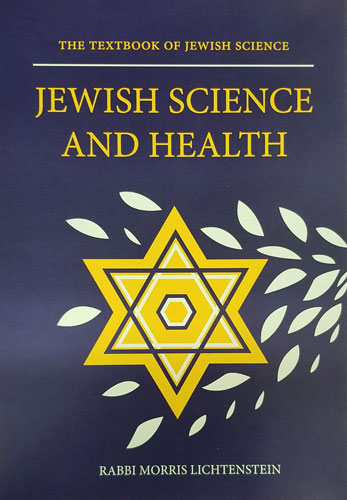
The first rabbi to write about Jewish Science was Alfred Geiger Moses. His book was popular in its time, and underwent a major revision later, but Moses did not choose to organize a movement around his ideas. However, fans of his book did seek to establish an organized movement. One of these organizations changed names and leadership a few times before hiring Rabbi Morris Lichtenstein. Upon becoming the rabbi, he changed the name to the Society for Jewish Science and published a “textbook” to serve as the basic text of the movement (replacing Moses’s text). Lichtenstein’s vision of Jewish Science differed from both Moses and Eddy on important points.
Lichtenstein stressed God as the Divine Mind and argued that the Divine Mind is omnipresent, loving, good, and responsive to prayer. This Divine Mind is also reflected in every aspect of God’s creation to some degree, including humanity. In fact, Lichtenstein claimed that human beings are the highest expression of the Divine Mind, reflecting divinity more than anything else because we are created in the image of God. And because God is around, within, and indeed a part of us, we can call on God when we are in need, trusting in God’s goodness and love. Lichtenstein’s theology rests on three main pillars 1) God’s goodness, 2) the Divine Mind’s presence in humanity and every aspect of the universe, and 3) the power of prayer as a connection with God. Each element can be found in the traditional theology of Judaism, which similarly teaches that human beings are made in the divine image, that God is good, and that God is near to us and answers prayer.
What differs is the emphasis on healing and the practice of affirmative prayer. In contrast to the Reform Movement, Lichtenstein emphasized personal piety and complete trust in God’s goodness even up to the point of hoping for a seemingly miraculous cure. Affirmative prayer is a prayer technique that developed with the Christian Science and New Thought movements wherein the individual imagines or affirms something to be true that is not yet true. For example, a person with a cold might affirm that their true nature is a state of health and imagine themselves in perfect health. While this practice can be abused as a method of self-delusion or denial of reality, if confined to a specific meditation practice it can be a useful tool for positive thinking. It is this latter sense that Lichtenstein taught.
Unlike the Christian Scientists, Lichtenstein did not discourage consultations with doctors or medical treatments. He taught that God is the Source of health regardless of the particular method used by a human being to achieve it. If medical science can provide reliable healing, it should be used, and affirmative prayer may help the healing process and provide other health benefits due to a positive outlook. Despite his emphasis on God’s responsiveness to prayer, he didn’t believe that God performed supernatural acts that disrupted the natural order. Rather, because God is present throughout creation and not separate from the universe, Lichtenstein taught that God’s responses came through natural processes that were activated by the Divine Mind within us. Thus, any healing that occurred was a natural result of applying spiritual principles to one’s life. Amazing acts of healing could occur from prayer, but they were not the supernatural acts of a supernatural God.
While health was certainly one focus of the Jewish Science movement, there were other far more important aspects to Jewish Science. Lichtenstein formulated a list of the Ten Fundamentals of Jewish Science:
- The Jewish Faith is the only faith we acknowledge. Jewish Science is the application of the Jewish Faith to the practice of life.
- We believe wholeheartedly in the efficacy of prayer. We believe that no prayer, when properly offered, goes unanswered.
- We shall endeavor every day of our lives to keep serene; to check all tendencies to violence and anger; to keep calm even in the face of unpleasant and discouraging circumstances.
- We shall strive to be cheerful every day of our lives. The Talmud says that the Divine Presence departs from one who is in gloom. It is God’s design that man should find joy and cheer in his existence on earth.
- We shall seek to cultivate an attitude of love and goodwill towards everyone. We shall make no room in our heart for hatred and bitterness. The world was created on a plan of divine love, and to admit thoughts of hatred or malice is to violate the plan of God.
- We shall cultivate a disposition of contentment, envying no one, and praising God for the good he has already bestowed on us. Contentment is the greatest friend of happiness; envy its greatest enemy.
- We shall make conscious effort to banish worry and fear from our lives. We regard these two as the greatest enemies of mankind and give them no place in our consciousness.
- We shall trust in God’s goodness in every circumstance of our life.
- We believe that death is an elevation to eternal life, and not a cessation of existence.
- We believe that God is the Source of health and the Restorer of health.
As can be seen in the above list, the major focus of the Jewish Science movement was concerned with character development, personal piety, and practical aims. In fact, the main type of healing that it seems Lichtenstein was concerned with was the healing of the soul, known in Hebrew as tikkun middot or tikkun hanefesh. There are obvious similarities to the Mussar movement with its focus on ethical development, but there are also similarities to Hasidism. Just as Hasidism upheld the ideal of devekut (clinging to and communing with God at all times), Jewish Science taught the idea of God-consciousness and upheld it as an ideal. God-consciousness is exactly what it sounds like: a constant awareness of the Divine Presence in all things, and we develop this God-consciousness through affirmative prayer. And just as Hasidism emphasized joy in the service of God, so did Lichtenstein encourage “cheer” and joy.
The parallel with these Eastern European movements is no coincidence. Morris Lichtenstein came to America from Lithuania, which was the birthplace of Mussar and of a few prominent Hasidic dynasties. Both currents of thought were present in his cultural milieu. And while affirmative prayer may have its origins in the broader New Thought movement, Lichtenstein found grounding for it also in traditional Jewish sources, particularly the Psalms. Lichtenstein upheld the Psalms as the highest expression of Jewish theology and prayer. Many of the Psalms are written in the affirmative with vivid poetic imagery and complete faith in God. For example: “The Lord is my shepherd, I shall not want. He makes me lie down in green pastures, leads me beside still water. He restores my soul.” Similarly, Psalm 37 states, “Seek the favor of the Lord, and he will grant you the desires of your heart. Leave all to the Lord; trust in him; he will do it.” Although there is precedent in Kabbalah for the practice of visualization, Lichtenstein does not explicitly make this argument, likely because most American Reform Jews at the time were unlikely to know much about Kabbalah or to take it seriously. But I believe he was likely aware of the use of visualization in Jewish mystical practices.
The Jewish Science approach to affirmative prayer consists of three steps. First is to calm the mind and recognize God’s Presence. Second is to affirm that God’s attributes are also present within us. Third is to visualize and/or affirm the presence of the quality or state of being we are in need of. To begin, a person must clear and calm their mind by sitting quietly with their eyes closed. It helps to begin with a focus on the breath and then move into a silent repetition of a phrase that is a reminder of God’s closeness. Once a state of calm and awareness has been achieved, the individual affirms that they are made in the divine image and that God is also present within themselves. In the third stage, the person visualizes the needed quality washing over them or filling them up in a metaphorical way. This can be visualized, for example, as a divine light descending onto them or a fountain bubbling up in the heart. If a person struggles with visualization, affirmations can be used instead or as a supplement. For example, if someone is trying to foster an attitude of love, they can say something like, “the love of God fills me and flows out of me to all people.” This practice should be done consistently, every day for about 10-15 minutes at a time.
Lichtenstein developed many affirmations that are scattered throughout his textbook Jewish Science and Health, but he formulated two affirmations that encapsulated his teachings. He encouraged his followers to recite these affirmations every day. They are: “I am calm and cheerful; I hate no one; I envy no one; there is no worry or fear in me; I trust in God all the time” and “The God-consciousness in me expresses itself in health, in calmness, in peace, in power, and in happiness.” Note how the first affirmation encapsulates most of the principles outlined in the “Ten Fundamentals of Jewish Science.”
The Jewish Science movement as it developed under Lichtenstein, and later under the guidance of his wife Tehilla, was an attempt at Jewish “revival.” This is a goal discussed explicitly by both Lichtensteins in their writings. Even though the primary target audience were secular and Reform-affiliated Jews, Lichtenstein claimed that his method was in harmony with all denominations of Judaism. As we’ve seen above, every element of Jewish Science is grounded in traditional and mystical forms of Judaism. Lichtenstein’s talent was in combining these elements into a spiritual discipline that could appeal to people attracted to Christian Science and other forms of New Thought. In many ways, Jewish Science was the forerunner of the Renewal Movement, an attempt to revive Jewish spirituality within a liberal Jewish framework.
Many of Lichtenstein’s contemporaries criticized his spiritual teachings as individualistic and personally oriented, rather than communally oriented. His silence regarding social justice was also seen as a defect in the Reform Movement, which then as now emphasizes social justice as a vital part of Judaism. It is true that the emphasis of Jewish Science is on personal spirituality, but this is a feature and not a bug. Unfortunately, the liberal Movements of Judaism have too often sacrificed personal piety for communal practice and a focus on bettering society. All three elements are necessary. Jewish Science was a much needed corrective for liberal Judaism in America. Without the personal aspects of spirituality, people have little to no reason to engage in communal worship. It is the sense of connection with the Divine that acts as the immediate motivation for religious behavior. While social justice and community are essential aspects of Judaism, so too is a personal relationship with God.
Unfortunately, Jewish Science has never been a large movement. At its height, it had no more than a few thousand members, but the potential for this movement remains alive and greater than ever. The American Jewish community engages much more openly with practices like affirmative prayer, meditation, and visualization that are similar to those taught by the Lichtensteins. Spiritual healing has also become a fixture of Jewish spirituality with many rabbis offering healing services. As non-Orthodox participation in Jewish religious life remains low, and even declines, personalized spiritual practices have proliferated. The teachings and practices of Jewish Science remain available through the Lichtensteins’ writings, waiting to be rediscovered.
 B'nei Ruth: Community for Applied Judaism